
How to penetrate tanks in World of Tanks: mechanics of armor and ricochets (2026)
Information is current as of August 2026.
“How did I not punch him?!” - the question that every tanker asks himself after a shot at the side, which ended with the inscription “did not penetrate.” The mechanics of armor penetration in World of Tanks are deeper than it seems: there are ricochet angles, normalization, caliber rules, and screens with tracks that eat up shells. We analyzed the official mechanics, added aiming practice, and collected typical errors from the comments.
How does the game count penetration?
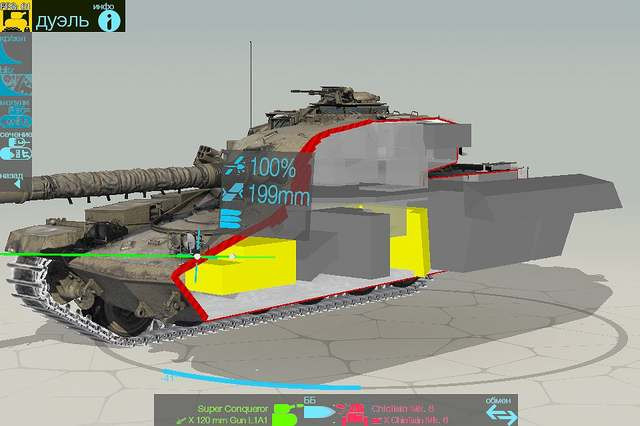
In a split second, the game goes through a chain of checks: it calculates the final armor penetration of the projectile (taking into account the distance), checks ricochet and the three-caliber rule, then calculatesgiven armorat the point of impact - the actual thickness, taking into account the angle of inclination of the sheet - and compares it with the penetration of the projectile. If the penetration is less - “did not penetrate”, if more - damage and a chance of damaging internal modules.
Key consequence:the slope of the armor works stronger than the thickness. A 100 mm sheet at an angle of 60° gives a reduced 200 mm. Therefore, the same tank penetrates “head-on” or does not penetrate at all, depending on the angle at which it stands. Hence the main skill of tanking - to turn the hull and turret, increasing the angles, and the reverse skill of the shooter - to shoot where the armor is level with you.
Ricochet and caliber rules
- Rebound angles:armor-piercing and sub-caliber shells ricochet when hit at an angle of 70°, special sub-caliber (BOPS) shells - from 80°, cumulative - from 85°, land mines do not ricochet at all.
- Rule of three gauges:if the caliber of the projectile is more than 3 times the nominal thickness of the armor, ricochet is excluded - a large caliber “pushes” thin sheets at any angle. That’s why the “bangs” punch through cardboard cars in the most ridiculous projections.
- Normalization:When hit at an angle, a kinetic projectile “turns” slightly toward the normal, reducing the effective angle of the armor (for armor-piercing ones it is 5°). HEAT shells do not have normalization - their weakness is against inclined armor and screens.
- Rule of two gauges:with a caliber twice the thickness of the armor, normalization increases - another argument of large guns against “cardboard”.
Screens, tracks and types of projectiles
Screens and tracks— separate layers: having pierced the screen, the projectile loses part of its penetration, and only then meets the main armor. Therefore, shots at a caterpillar at an acute angle often give a “failure to penetrate” - the projectile is eaten by the shielding layer. But the “blocked damage” on the caterpillar is recorded and goes into the tanker’s statistics.
Types of projectiles in practice:armor-piercing (basic) - universal and cheaper; sub-caliber “gold” ones - higher penetration and speed, but lose penetration more strongly with distance; cumulative ones do not lose penetration with distance, but are afraid of screens, tracks and inclined armor, and after the first obstacle they lose penetration along the flight of the jet; land mines - with low penetration, but with damage even if not penetrated (adjacent damage) and a high chance of critical modules - a "bang" weapon and the scourge of "cardboard" targets.
 Which tanks to download in World of Tanks in 2026: the best branches