
Smurfs in Dota 2 and behavior score: why there are more of them and how to survive (2026)
Information is current as of August 2026.
Smurfing in Dota 2 has become the main complaint of the community after balance - and in the rating ranks from Herald to Legend, perhaps the main one in general.The topic is simmering on Reddit, in Steam discussions and in Russian-speaking communities: players are en masse facing opponents whose real level is thousands of MMR higher than stated. In 2026, the problem was aggravated by a new round - changes to the behavior score system, after which players began to accuse Valve of “fining you for dying to the Smurfs.” Let's figure out what's going on, why there are more Smurfs and how to live with it.
Who are the Smurfs and why are there more of them?
A smurf is an experienced player who creates a new account or deliberately loses his rating on the main one in order to play against obviously weaker opponents. The reasons are different for everyone: some want easy victories and a sense of superiority, some play with low-ranking friends, some avoid long queues at high MMR, and some make money - boosting accounts and calibrating for sale remains a whole gray industry, despite all the prohibitions.
Formally, smurfing has been prohibited by Valve rules since 2020, and the company periodically conducts ban waves. The largest one happened in December 2022, when tens of thousands of accounts, including smurfs of professional players, were targeted. However, in 2025–2026, Valve’s activity in this direction noticeably decreased: there have been no large public ban waves for a long time, and the community rightly believes that the problem was actually left to chance. Against the background of online stagnation, new accounts are registered willingly - a free game without a paid number attached to each profile makes creating a Smurf a matter of half an hour.
A separate inflow channel is calibration services and account sales. The market for ready-made accounts with the required MMR continues to operate: the buyer receives an account with already played calibration and immediately gets into rating games, where the system does not understand for a long time that his real level does not correspond to the figure. For an honest player on the lane, this looks equally painful: the opponent on the mid lane with an 80% win rate in the last twenty games, who is finishing off the last hits like a bot in training - only very angry.
Behavior score: the invisible hand of matchmaking
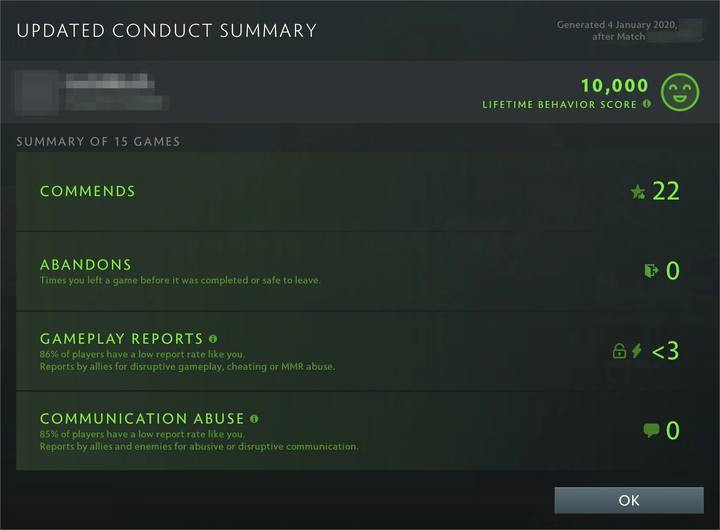
Behavior score is a previously hidden but now displayed system that evaluates your behavior in matches on a scale of up to 12,000 points. Every 15 games you receive a summary: how many commends (praises) and reports you collected, whether there were any leaks or kicking allies. A high behavior score gives priority in the search and inclusion in teams of the same “calm” players; the low one sends you into a pool with toxics, livers and feeders - in fact, this is a hidden prison, from which you can only get out by politely playing dozens of matches in a row.
In the winter of 2025–2026, the system received an update, which became the reason for a new scandal. Valve has tightened penalties for “abnormal death statistics” - the system tried to calculate an intentional feed based on death patterns. The side effect was not long in coming: players who found themselves in a match against a Smurf and died from him over and over again (which is natural with a difference of 3000 MMR) received a minus to their behavior score for “suspicious mortality.” On Reddit and forums, this instantly took shape in a meme: “Valve is punishing you for being killed by a Smurf” - and in essence the complaint is fair. A person pays twice: with a lost match and a decrease in behavior rating, which is then restored for a month in games with irritated toxics.
At the same time, the economy of reports and commendations has worsened. After a major overhaul of the reporting system, reports became “weighty” again, and comments became the main way to raise the behavior score. This has given rise to a market for mutual likes in chats after a match and, conversely, report wars in lost games: the losing team often massively reports the weakest ally simply out of frustration, and the algorithm does not always distinguish a real ruiner from a newcomer who was unlucky with the team.
 Is Dota 2 dying: online, prize money and the future of the game in numbers (2026)