
Farming and economics in Dota 2: finishing moves, jungle stacks and timings (2026)
This information is current as of August 2026.
In Dota 2, gold matters more than flashy ultimates: a team with a gold lead of 10,000 by the 20-minute mark wins the vast majority of matches. At the same time, farming is the most underrated mechanic among low- and mid-tier players: everyone watches kill highlights, while pro players look at the gold chart. Let’s break down Dota’s economy systematically: last-hits, lane balance, jungle camps, and the main question—when to farm and when to fight.
Last Hits: The Foundation of the Economy
The main source of gold is last hits on creeps. A last hit on a low-tier creep yields significantly more gold than the creep would provide “on its own,” so the difference between a player with 30 last hits and one with 60 by the 10-minute mark is a whole item. Benchmarks for self-assessment as a carry: 50–60 creeps by the 10-minute mark is good; 70+ is high-rank level. This is practiced separately: in a hero’s demo mode or a lobby without opponents, spending ten minutes on last-hitting under the tower and away from it—two weeks of such five-minute training sessions yield more than a month of “just playing.”
The second half of laning is denying (killing your own creeps): by depriving the enemy of gold and some experience, you win the lane without a single fight. Enable “right-click to last-hit your own” in the settings and get into the habit of watching not only enemy creeps but also your own. The third element is aggro: attacking an enemy hero in the creep zone draws the creeps toward you, and skillfully managing aggro allows you to pull creeps toward yourself for safe last-hitting.
Lane Balance: Why You Can’t Just Push
New players constantly attack creeps—and the lane inevitably drifts under the enemy tower, where farming is dangerous. A proper lane stays near your tower (but not directly under it): finish off minions at the last moment, pull your own minions back, and when the wave does push forward—use pulls: the support pulls your wave into the neutral camp, the lane retreats, and the enemy loses creeps. Blocking the first wave at the start—using your body to hold back your creeps so the encounter happens closer to your tower—is a small ten-second adjustment that sets the entire geometry of your laning phase.
Jungle: Stacks, Farming Rhythm, and Timing
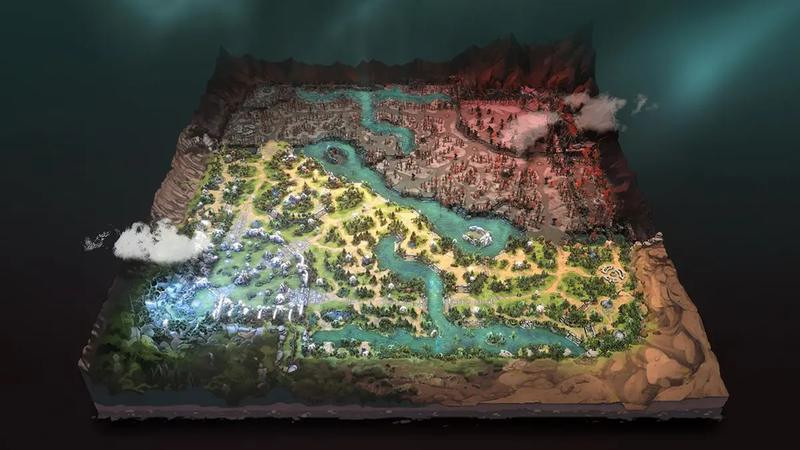
Neutral camps are the second economic driver. Basic mechanics: camp stacking—if you clear the neutrals from the spawn zone around the 53–55-second mark, a new wave will spawn in the camp and the old one will return: a double camp. The support farms the camps for the carry (this is a direct transfer of gold to the team), and a hero with fast clear picks them off. Dota Map — Timing: Runes of Wisdom appear at the edges of the map every seven minutes and grant experience; Runes of Wealth and Empowerment in the river appear every two minutes at specific time marks. The Tormenor becomes available mid-game and grants a free Aghanim’s Shard to one of the supports, while Roshan means the Aegis and a turning point in the entire game. The team that knows the timings takes the objectives first—and turns them into gold and pressure.
When to Farm and When to Fight
Dota’s main economic question doesn’t have a simple answer, but here’s a practical rule of thumb: Farm if you’re a carry without key items, if your team is stronger in the late game, or if the enemy can’t punish your farming. Fight if you have a “window of opportunity”—a fresh ultimate, a key item, or a numerical advantage—because windows close. The worst decision is to take half measures: a carry who rushes into every fight and dies ends up losing both farm and fights. Check the map before every move: if three enemies have disappeared from the minimap, the safe jungle is no longer safe—which is exactly why wards are an economic item, not just a “support’s responsibility.”
Neutral Items and Patch 7.41
Neutral items, which drop from jungle camps by tier, are a separate aspect of the economy. After Patch 7.41, the system became deterministic: randomness was reduced, and choosing the right neutral item for your hero became yet another mini-optimization. The advice is simple: don’t ignore them, and don’t be greedy—a neutral item of the right tier provides free stats, and passing it to a teammate who needs it more is just as much a part of team economy. And don’t forget about lotuses, mushrooms, and other new map resources: Dota 2026 is generous to those who know its finer mechanics.
Player Feedback
Players call farming “the most boring mechanic that wins the most games.” Veterans share classic wisdom: “I boosted my MMR by a thousand just by stopping dying on lane and starting to finish off creeps,” “stacks for the carry are a support’s love language.” Newcomers, on the other hand, honestly admit that laning is the least intuitive part of Dota: “I thought I just had to hit creeps, but it turned out I was helping the enemy for half an hour.” After 7.41, deterministic neutral creeps were warmly welcomed—“I finally stopped losing the shot lottery.” The 30-minute catapult, however, received mixed reviews: carries love it for the extra pressure, while supports love it because the line pushes toward the enemy faster than you can react.
Analysis of Comments
In discussions about the game’s economy, there’s a solid consensus on three points. First: finishing off enemies is the only skill that pays off in any role and at any rank, and it needs to be practiced separately from matches. Second: at ranks below Legend, games aren’t won by drafts or strategies, but by a simple difference in gold—“they have a carry with a 400 GPM compared to ours with 300; there’s no need to look any further.” Third: the map is more important than your hand—players who’ve started checking the minimap every five seconds describe it as “turning on the light in a dark room.” And the main motto of all economic guides, which the community repeats in unison: in Dota, there’s no such thing as “free” twenty seconds—every second you spend doing nothing is gold you’ve gifted to your opponent.
See also
- Dota 2 for Beginners—Where to Start and Which Heroes to Choose;
- Best Dota 2 Heroes — Patch 7.41 Meta by Role;
- How to Increase Your MMR—A Proven System for Gaining +300 to +500 Rating;
- Patch 7.41 and the #MDGA revolt—what has actually changed;
- Smurfs and Behavior Score — How to Survive Matchmaking;
- Is Dota 2 dying? Online stats, prize pools, and the future in numbers;
- Best Dota 2 Settings — Videos, Keybinds, and Interface for Victory;
- Roles and Positions in Dota 2—From Carry to Hard Support;
- All About Dota 2 — Game Overview: History, Popularity, and Statistics.
Sources: Dotabuff—gold statistics and charts, Russian Dota 2 Wiki, Dota2.ru.
More about Dota 2
- Dota 2 for beginners in 2026: where to start, which heroes to choose and how not to quit the game (2026)
- How to increase MMR in Dota 2 in 2026: working system from +300 to +500 rating (2026)
- The best Dota 2 heroes in 2026: 7.41 patch meta by position (2026)
- Best Dota 2 settings: videos, hotkeys and interface for winning (2026)
- Patch 7.41 for Dota 2 and the #MDGA riot: why players bombed reviews and what really changed (2026