
Scammers on Telegram: How Scammers Steal NFT Gifts and How to Avoid Becoming a Victim (2026)
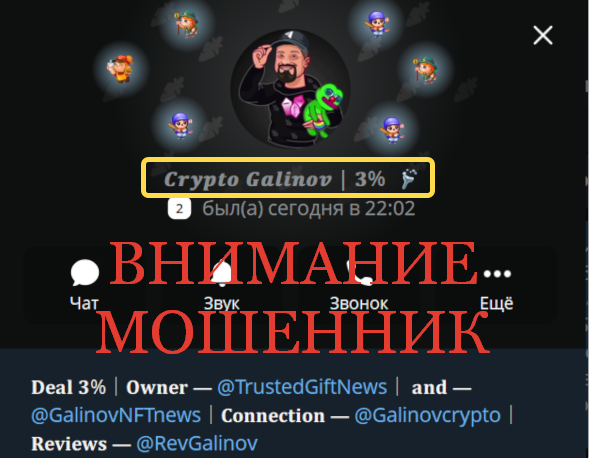
Scams on Telegram have long gone beyond the typical “you’ve won a prize” schemes. With the emergence of NFT giveaways, scammers have found a new way to deceive people: they trick users into handing over digital collectibles by promising payment, and then simply block the victim. We’ll break down a real-life case and explain how to avoid becoming the next victim.
What Happened: A Real-Life Case from September 1, 2026
A reader named Masha reached out to us with a story about a scam. According to her, a user with the handle @Galinovcrypto (profile “Crypto Galinov | 3%,” posing as a guarantor for NFT transactions with a 3% commission) agreed to purchase rare NFT gifts from her child. After the gifts were transferred, payment was never received: the seller was blocked, and no one is responding to messages.
Judging by the screenshots, these are collectible Telegram NFT gifts, including the rare Candy Cane #133,587 featuring the Joker (rarity 2.6%), the Earlap Hat pattern (0.2%), and the Fandango background (1.2%). The approximate value of this item at the time of the transaction was about 4,000 rubles, and the child owned an entire collection of gifts, including figures with numbers #5,247, #20,288, #23,385, and others.
The screenshots show that the gift was transferred to the “new owner” via Telegram’s built-in mechanism—after which it is impossible to return it on one’s own. The buyer’s profile, however, looked legitimate: the stated status of a verified guarantor, 24/7 availability, and links to channels with reviews. It was precisely this appearance of reliability that turned out to be the main trap.
We are publishing this story at the request of the victim as a warning. If the owner of the profile in question is willing to discuss the situation, return the NFT gifts, or reimburse their cost, they can contact Masha—the contact information has been provided to her personally.
How This Scam Works
- The “honest guarantor” persona. The scammer sets up a profile posing as an intermediary: a 2–3% commission, links to channels with “reviews” (often faked or bought), and a professional tone. Sometimes they buy accounts with an established history or hack into existing ones.
- Pressure and urgency. The victim is offered a favorable price and asked to send the gift first—“after all, I have a reputation, and you’re a nobody.”
- Instant transfer. NFT gifts on Telegram are transferred with a single click and are irreversible. Once the item is gone, only the new owner can return it—voluntarily.
- Blocking. After receiving payment, the seller is blocked; the “guarantor’s” account either continues to target new victims or is renamed.
- A particularly cynical tactic is targeting children and teenagers who collect these gifts and are unaware of the risks.
How to Avoid Getting Scammed: Rules for Safe Transactions
- Never send the gift first. Payment first, then delivery. Any claim like “I’m a reputable seller—you can’t start with me” is a red flag.
- Use only official platforms. Sell NFT gifts through marketplaces with escrow mechanisms (for example, Fragment for TON assets), rather than through private arrangements.
- Verify “guarantors.” Legitimate guarantors operate through well-known bots and platforms, not via private messages. A profile that says “verified guarantor” proves nothing—this person has not undergone verification on Telegram.
- Fake reviews aren’t proof. Review channels can be set up in a single day, and comments are bought.
- Talk to your children. If your child collects gifts or plays with NFTs, explain to them: they must never hand over items to anyone until they receive payment, and they must immediately tell their parents about any purchase offers.
- Save evidence. Screenshots of the conversation, the profile, and the moment of transfer will be needed for a complaint and a possible report to the police.
What to do if you’ve already been scammed
File a complaint against the scammer’s account directly on Telegram (use the “Report” button on their profile), and contact official support at @notoscam and antifraud@telegram.org, attaching screenshots. If you’ve suffered significant losses, file a fraud report with the police—NFT gifts have market value, and your chat history and transfer records confirm the transaction. Also, warn the relevant chat groups and communities where the scammer is active: scammers thrive on their victims’ silence.
Be careful and do not transfer digital assets to strangers in the hope that they will act honestly. There is no “cancel transaction” button on Telegram—your own caution is your only protection.